Benchpad blog
You don't need a productivity system
The entire productivity industry is built on the assumption that you need a system. What if you just need a blank page?

GTD. Zettelkasten. PARA. Building a Second Brain. The Bullet Journal Method. Pomodoro. Time blocking. Eat the Frog.
These are some of the productivity systems that have been invented to help people do things. Each has books, courses, communities, certified practitioners. Each promises that if you follow the system, you will be more productive.
Here's the thing nobody selling these systems wants you to consider: most productive people don't use any of them.
The system paradox
Productivity systems have a paradox at their core: the people who are most attracted to them are the people who least need them.
If you care enough about productivity to research systems, you're already more conscientious than average. You'd probably be fine with a text file and a to-do list. The system isn't what makes you productive — your disposition is. The system just gives your conscientiousness something to fidget with.
Meanwhile, the system itself becomes a task. Learning it. Implementing it. Maintaining it. Tweaking it when it doesn't feel right. Migrating to a new one when the current one feels stale.
The system becomes overhead — work about work that displaces actual work.
What productive people actually do
If you study consistently productive people — writers, programmers, scientists, entrepreneurs — a pattern emerges. It's not a system. It's a set of habits:
They write things down. Not in a special way. Not in a carefully organized system. They just write things down so they don't forget them.
They keep short lists. Not databases of tasks with priorities, due dates, and contexts. Short lists. Things they need to do today or this week.
They show up. They sit down and do the work, usually at the same time every day. This isn't a "system." It's a habit.
They don't organize much. Their desks might be messy. Their files might be disorganized. They don't care, because they're too busy doing the work.
This is unglamorous. It doesn't sell books. It doesn't generate YouTube views. But it's what actually works.
The dark side of systems
Productivity systems have costs that their proponents rarely mention:
Cognitive overhead. Every system has rules. Rules require working memory to maintain. Where does this task go? What's its context? When should I review it? Each rule is a small cognitive tax.
Guilt. When you fall behind on your system — and you will — you feel guilty. The system was supposed to help. Now it's a source of shame.
Premature optimization. Systems encourage you to organize before you have enough material to organize. You build folder structures for projects that don't exist yet. You create databases for data you haven't collected. You're optimizing the container when you should be filling it.
Identity entanglement. "I'm a GTD person." "I use Zettelkasten." When your productivity system becomes part of your identity, abandoning it feels like losing a part of yourself — even if it's not working.
The blank page alternative
What if the answer isn't a better system but no system at all?
Not chaos. Not disorganization. Just a blank page.
You have something to write? Write it. You have something to do? Write it down. You need to think through a problem? Write about it. The blank page is the system. It doesn't have rules. It doesn't need maintenance. It's always ready.
Three blank pages, actually. One for each area of your life that needs a scratch space. That's it. That's the entire system.
Why this works
The blank-page approach works because it removes everything that makes systems fail:
- No rules to remember. You write in one of three places. That's the only rule.
- No maintenance to fall behind on. There's nothing to maintain.
- No guilt. You can't be "behind" on a blank page.
- No premature optimization. There's nothing to optimize.
- No identity. You're not "a Benchpad person." You're a person who writes things down. The tool is irrelevant.
The productivity industry wants you to believe that the right system will unlock your potential. The truth is simpler: your potential is already unlocked. You just need a place to write things down.
Benchpad is three scratchpads. Not a system. Just a place to write. $10/year. Start writing free →
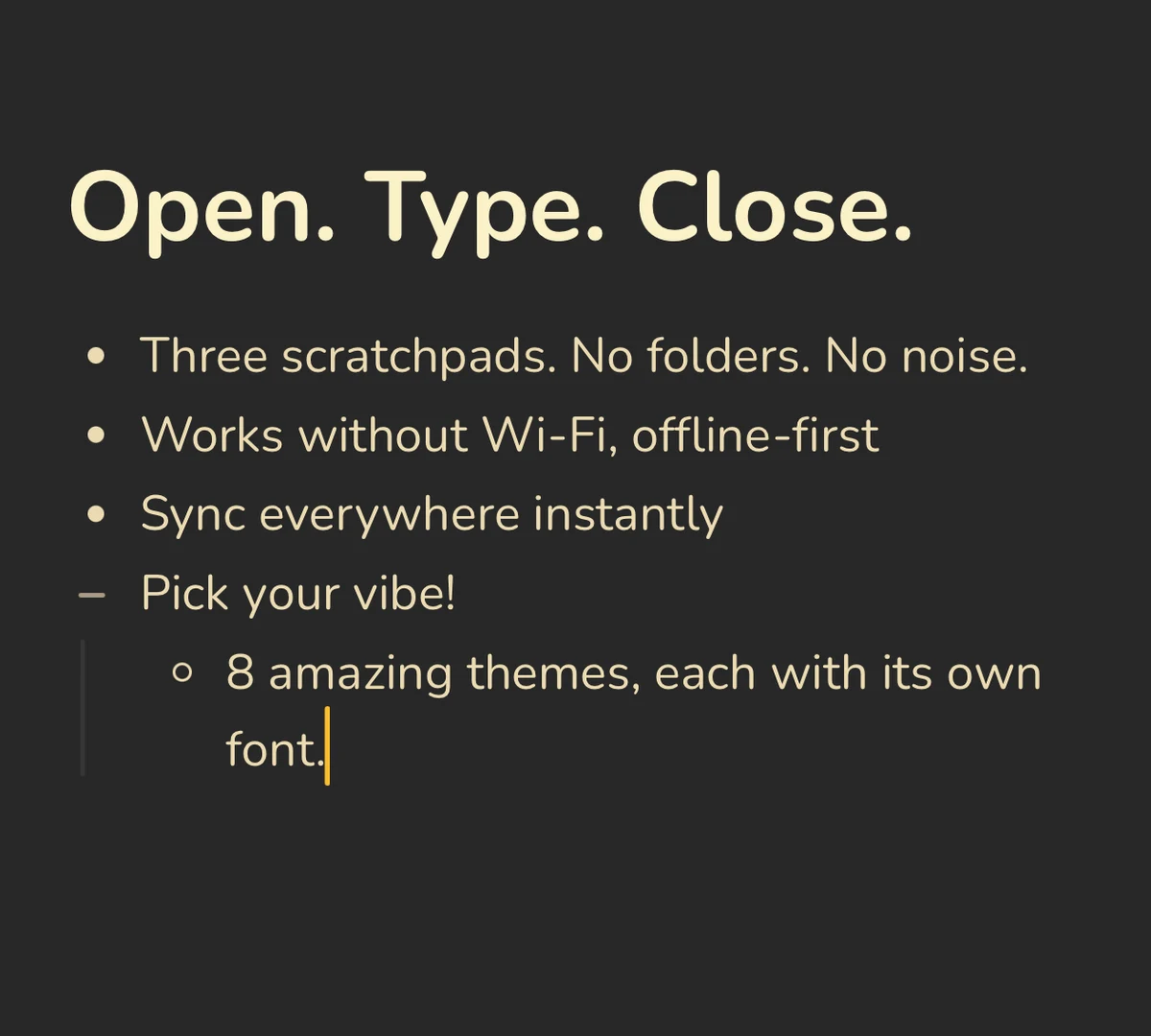 Benchpad Interface
Get Benchpad
On every platform
Native apps for iPhone & Android, and a Mac menu bar & Windows tray app — same three pads, offline-first, synced everywhere.
Benchpad
Try it free.
No credit card required.