Why
The day I stopped switching note apps.
I didn't find a better one. I gave up on finding the perfect one.
Every app I tried kept adding features. Each new feature was a small decision I had to make before I could write — where does this go, should I tag it, is there a template for this. The overhead was invisible at first, then it wasn't.
The simplest version of note-taking — open something, type, close it — had been engineered out of every tool I used. So I built it back.
What Benchpad is
Three scratchpads. Name them anything. Each pad is made of sections — named blocks you can collapse, reorder, and fold. Open a pad, write in a section, close it. When you're online, everything syncs in the background. When you're offline, it works exactly the same.
That's the whole product. Not the MVP. The product.
No folders. No tags. No databases. No AI. No second brain. No integrations. No plugins. No weekly feature announcements. No onboarding flow.
What Benchpad is not
If you've used Notion, Obsidian, Logseq, Roam, or Bear — and found yourself spending more time on the system than on the work — that's the problem Benchpad solves.
Notion is a workspace. Obsidian is a knowledge graph. These are powerful, serious tools for people who need power and complexity. Benchpad is for people who've realized they don't.
There's no shame in that. Most of the best thinkers I know keep their notes in a single text file.
Why it costs money
$10 a year. Here's why that number is intentional.
Free tools disappear. Google Reader. Wunderlist. Sunrise Calendar. The graveyard of free productivity tools is long. They die because they have no revenue. We want Benchpad to be here in 10 years.
Free tools don't get used. When something costs nothing, it's easy to sign up and never come back. When you pay — even a little — you've made a commitment. Commitment is good for note-taking.
We don't want your data. You pay for the tool. That's the entire business model. No ads. No analytics on your content. No upsells.
Your subscription keeps us online so you can stay offline.
Why three files
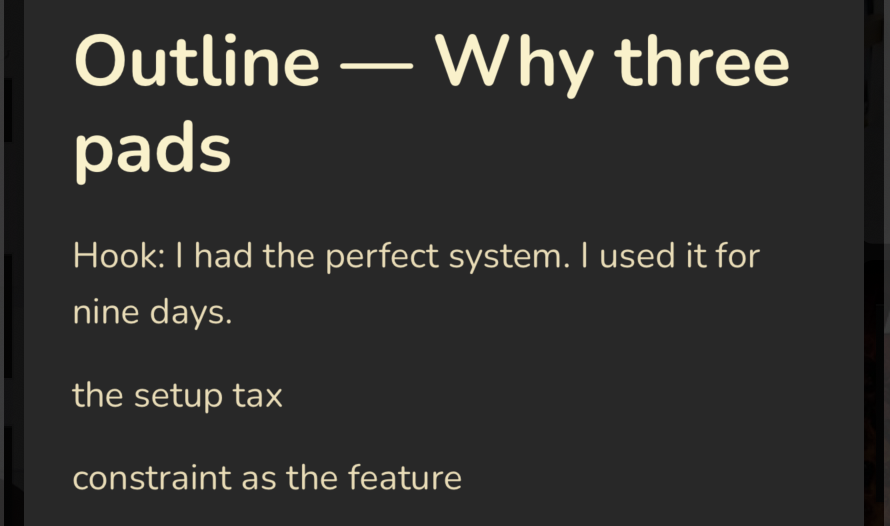
Three is enough. If your life doesn't fit into three buckets, you probably need a project management tool, not a scratchpad.
Name them Work, Personal, Scratch — or whatever. The names don't matter. What matters is that you never wonder where something goes, because there are only three places it can go.
"But what about projects?" A project is a heading. Use one.
"But what about reference material?" Put it in a pad. Add a heading.
"But what about—" It goes in one of the three scratchpads. We promise.
Scratch is meant to be cleared
A pad is a working surface, not an archive.
Active thinking belongs in your scratchpads. Draft the email, outline the project, track the todo list. When it's done, you decide what happens: keep it in the pad, copy the keeper out, or clear it. There's no folder to file into and no pile that only grows. The pad stays the size of what you're working on now.
Most tools make you curate everything forever. Benchpad lets you let go.
Why offline-first
Because your thoughts don't wait for wifi.
Benchpad saves to your browser first. Sync is a background luxury, not a requirement. If our servers go down, you don't notice. If your internet goes out, you don't notice. If you're on a plane, a train, or a basement with no signal — you don't notice.
That's not a feature. That's respect for your time.
Your data won't disappear
Most apps pick a winner when two devices edit the same file at once. One version survives. The other is silently deleted. You've probably lost notes this way without knowing it.
Benchpad uses conflict-free replicated data types — the same technology behind Figma and Google Docs. When you edit on your laptop offline and your phone at the same time, both changes merge at the character level. Nothing is overwritten. Nothing is lost.
Your content is plain text. Copy it, paste it anywhere, email it to yourself. No export step. No proprietary format. No lock-in. It's just text — it just happens to be indestructible.
An honest word on privacy
Your notes are encrypted at rest on our servers. In plain terms: if someone stole our database, they'd see encrypted data, not readable text. This is standard cloud security, and we're disclosing it plainly.
This is not end-to-end encryption. We're not going to claim something we haven't built. True E2EE would mean we're mathematically incapable of reading your notes. We're not there — and we'd rather tell you that than market our way around it.
What we can tell you plainly: there is no business model here that involves reading your notes. No ads. No ML training. No analytics on your content. You pay $10 a year. That's it. We'd have to be idiots to jeopardize that by mishandling your data.
Your notes also live in your browser's local storage. If you cancel, delete your account, or we disappear tomorrow — your notes are still there on your device. They were never exclusively ours.
Who it's for
People who want to open something, type something, and close it.
People who've spent more time configuring their note system than using it, and are done with that.
People who understand that the best writing tool is the one you actually open.
If that's you, welcome.
Free forever. No credit card. Plain text. Leave anytime.