Benchpad blog
Why creative constraints make you more productive
Unlimited options don't unlock creativity — they paralyze it. The most productive people work inside constraints, not around them.

In 1960, Dr. Seuss bet his publisher he could write an entire book using only 50 different words. The result was Green Eggs and Ham, which became one of the best-selling children's books in history.
The constraint didn't limit the work. The constraint was the work.
This isn't a cute anecdote. It's a reliable pattern across every creative field: the most interesting work comes from constraints, not from freedom. Unlimited options don't unlock creativity — they diffuse it. You spend your energy choosing instead of making.
The paradox of unlimited
When everything is possible, nothing is urgent.
Give a painter a blank canvas and every color, and they'll stare at it. Give them three colors and a deadline, and they'll paint something.
Give a writer an empty document and every formatting tool, and they'll spend 20 minutes choosing a font. Give them a text box and say "500 words by 3pm," and they'll write.
This is the paradox of unlimited: infinite possibility feels like freedom, but it functions like paralysis. The brain isn't good at selecting from infinite options. It's good at working within finite ones.
Constraints in software
Most productivity software is designed around the idea that more options = more power. More templates. More integrations. More views. More customization.
But the research on creative constraint suggests the opposite: more options = more friction. Every option is a decision. Every decision is energy. And energy spent deciding how to organize your notes is energy not spent on the actual thinking.
This is why the "blank page problem" exists in every powerful note app. You open Notion, Obsidian, or Roam, and the first thing you have to do is decide: what kind of page? which database? what template? what properties? You haven't started writing, and you've already made five decisions.
How constraints help
Constraints help in three specific, well-documented ways:
1. They eliminate decision overhead. If you have three places to write and no folders, you don't decide where something goes. You put it in one of three places. The constraint made the decision for you.
2. They force prioritization. When space is limited, you can't keep everything "just in case." You keep what's important and let go of the rest. This isn't a loss — it's the entire point. Most of what you write down isn't important a week later. A constrained system helps you discover that faster.
3. They create focus through elimination. When there are fewer things to do, the thing in front of you gets more attention. A tool with three features doesn't pull your attention in three directions. A tool with three hundred does.
The Benchpad constraint
Benchpad gives you three scratchpads. No folders, no sub-pages, no unlimited notebooks. Three named pads.
This is the core constraint. It shapes everything about how you use the tool:
- You don't organize. There's nothing to organize.
- You don't accumulate. There's nowhere to accumulate.
- You don't decide where things go. You have three options and you already know which pad is for what.
The constraint does the cognitive work that, in other tools, you have to do yourself. You trade flexibility for clarity, which turns out to be a very good trade for most people's daily writing.
The resistance to constraints
People resist constraints in their tools for the same reason they resist constraints in other areas: it feels like losing capability. "What if I need more than three? What if I need folders? What if I need to link things?"
These are reasonable questions. The answer is: if you genuinely need those things, Benchpad isn't for you. But most people who think they need unlimited notes actually just need a place to write things down, and they've confused "keeping everything" with "being productive."
Keeping everything is the opposite of productive. It's the creation of an ever-growing archive that you maintain instead of use.
Benchpad is three constrained scratchpads. That's the feature. $10/year. Start writing free →
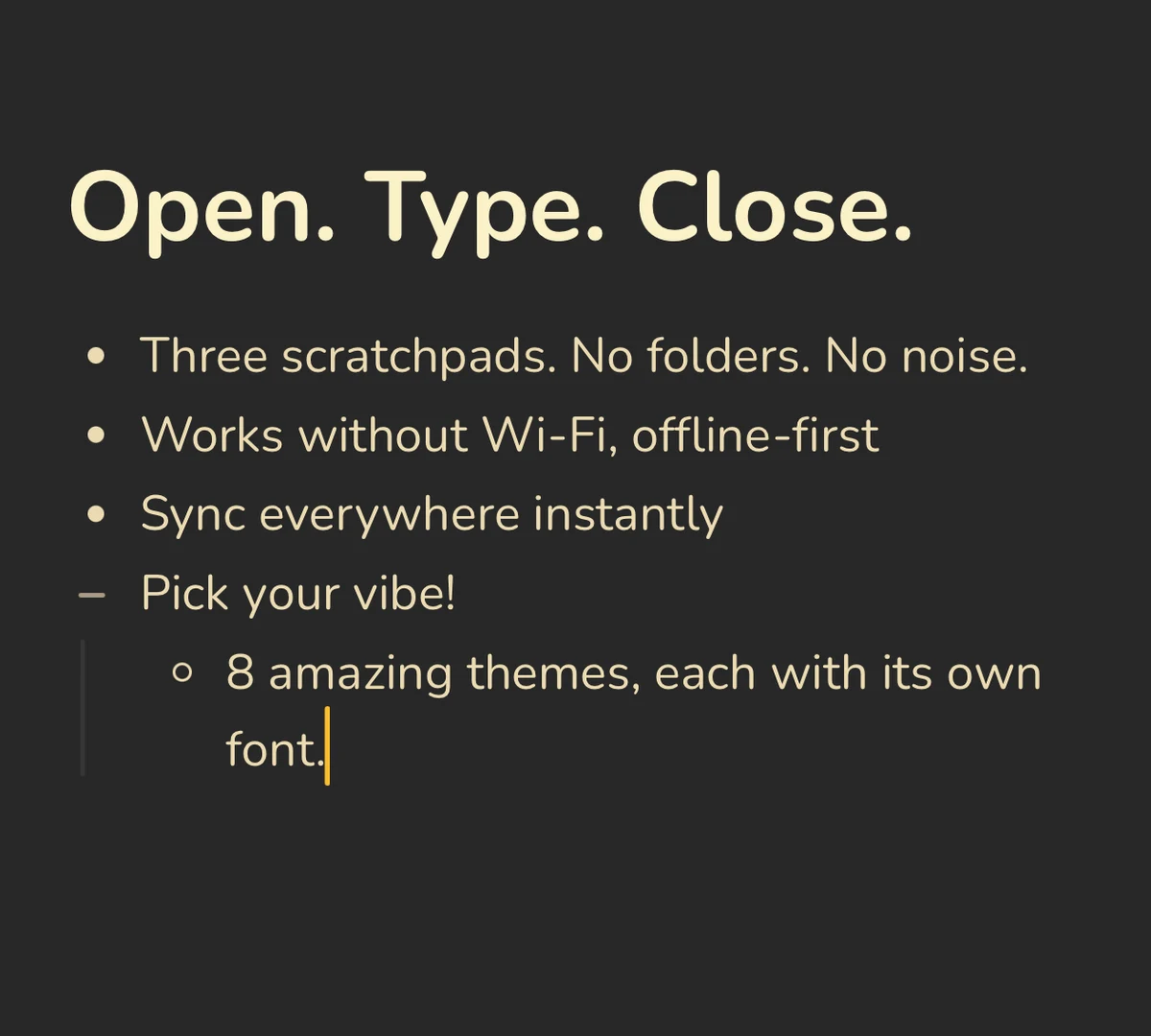 Benchpad Interface
Get Benchpad
On every platform
Native apps for iPhone & Android, and a Mac menu bar & Windows tray app — same three pads, offline-first, synced everywhere.
Benchpad
Try it free.
No credit card required.