Benchpad blog
Vannevar Bush described your note app in 1945. We still haven't built it.
In 'As We May Think,' Vannevar Bush imagined a machine that would store and retrieve personal knowledge the way human memory actually works. 80 years later, we're still getting it wrong.
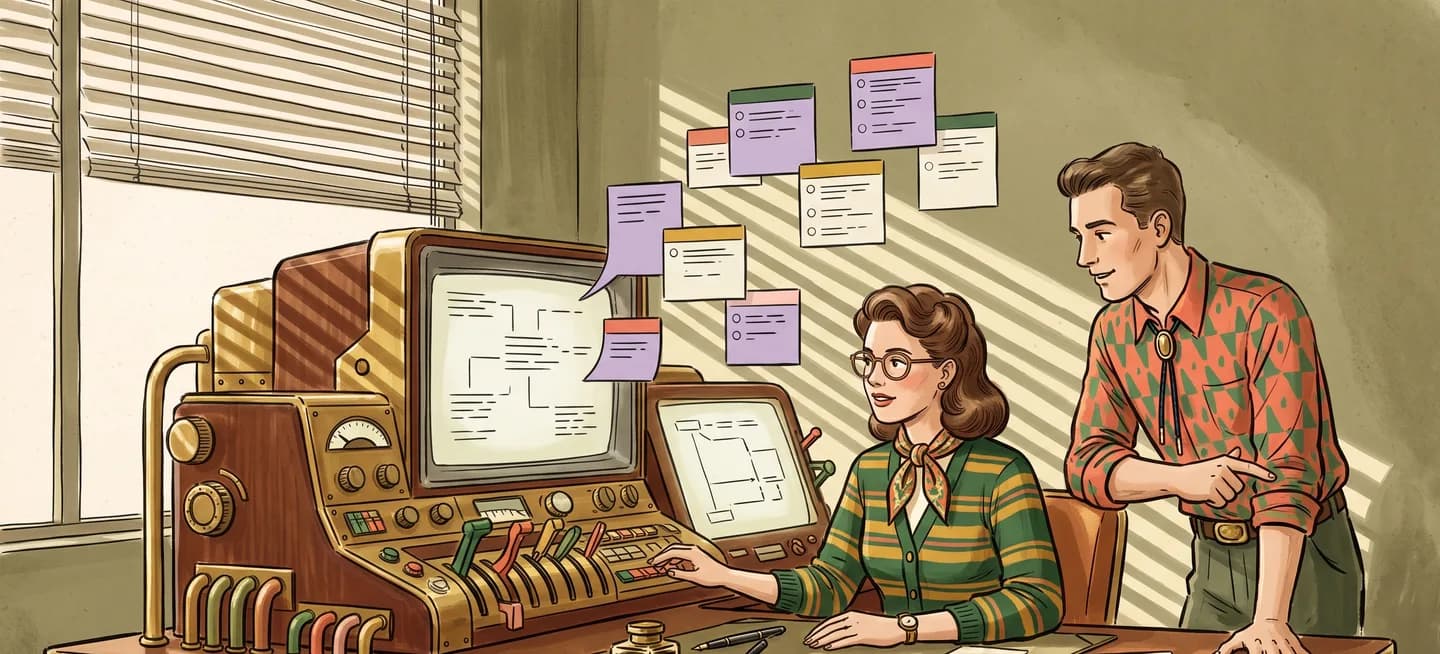
In July 1945, the Atlantic Monthly published an essay by Vannevar Bush, then director of the U.S. Office of Scientific Research and Development, titled "As We May Think."
Bush had just overseen a research effort involving 30,000 scientists and produced, among other things, the proximity fuse, radar improvements, and early work on nuclear weapons. The war was effectively over. He was thinking about what scientists should do next — and, more broadly, about a problem he'd been watching for decades: the growing impossibility of keeping up with human knowledge.
The essay is 10,000 words and reads like science fiction. But it is not fiction. It is a design document for something that didn't exist yet and, in certain crucial respects, still doesn't.
The problem Bush identified
Bush began with what he called the "growing mountain of research." Knowledge was accumulating faster than the tools to navigate it. Scientists were duplicating work done by colleagues they'd never heard of. Important connections went unmade because no one could read everything.
"The investigator is staggered by the findings and conclusions of thousands of other workers," he wrote. "He cannot find time to grasp, much less to remember, all the conclusions of others as they appear."
This was 1945. There was no internet. The problem was managing the scientific literature of a single century. Bush was already finding it unsolvable.
His proposed solution was a device he called the Memex.
The Memex
"Consider a future device for individual use," Bush wrote, "which is a sort of mechanized private file and library. It needs a name, and to coin one at random, 'memex' will do. A memex is a device in which an individual stores all his books, records, and communications, and which is mechanized so that it may be consulted with exceeding speed and flexibility. It is an enlarged intimate supplement to his memory."
The Memex was imagined as a desk. Microfilm inside. You could retrieve any stored document by code. You could annotate marginally. You could create links between documents — what Bush called "trails" — so that following a chain of connected material was as easy as following your own thought associations.
The key innovation was the trail. Bush was scathing about existing classification systems:
"Our ineptitude in getting at the record is largely caused by the artificiality of systems of indexing. When data of any sort are placed in storage, they are filed alphabetically or numerically, and information is found (when it is found) by tracing it down from subclass to subclass. It can be in only one place, unless duplicate copies are used; one has to have rules as to which path will locate it, and the rules are cumbersome. Having found one item, moreover, one has to emerge from the system and re-enter on a new path."
"The human mind does not work that way," he continued. "It operates by association. With one item in its grasp, it snaps instantly to the next that is suggested by the association of thoughts."
The Memex would mirror this. You'd read two documents, notice a connection, and build a named trail linking them. Later, following that trail, you'd move through the linked material as your mind would have moved — association to association.
This is, obviously, the intellectual grandfather of hypertext, the World Wide Web, and bidirectional link systems like Roam and Obsidian. Bush described all of it in 1945. He described it as an individual tool, not a network — he was imagining private trails through personal knowledge, not a shared information infrastructure.
What happened when people tried to build it
Doug Engelbart read "As We May Think" in 1945 and spent the next twenty years trying to build the Memex.
His 1968 demonstration — known as "The Mother of All Demos" — unveiled, live, for a stunned audience: the mouse, windows, hypertext, collaborative real-time editing, and video conferencing. Engelbart built the future in one afternoon, live, at the Fall Joint Computer Conference in San Francisco. The audience didn't quite know what to do with what they'd seen.
Engelbart's project, NLS (oN-Line System), was explicitly an attempt to build Bush's vision. What he built was more powerful than the Memex in every technical respect — and less used.
The problem was complexity. NLS required substantial training. Its command structure was dense. It was designed for deeply expert users who would invest weeks in learning it before becoming productive. Engelbart believed this was appropriate — the tool was powerful enough to justify the investment. The market disagreed.
Xerox PARC took Engelbart's insights and simplified them into the GUI — the graphical user interface that became the Mac and then Windows. They stripped out most of the power. What they kept was the parts that required no learning.
This is the first instance of a pattern that would repeat: the ambitious version of the Memex gets built, and the market chooses the simpler version that sacrifices power for immediacy.
Ted Nelson and Xanadu
In 1960, a teenager named Ted Nelson read Bush's essay and began designing a global hypertext system he called Xanadu.
Nelson invented the word "hypertext" in 1963. His vision was more radical than Bush's: not private trails but a global, bidirectional linked document system. Every document would be connected to every document it quoted or referenced. Every version of every document would be preserved. Ownership and attribution would be tracked with granularity. You'd be able to read any document's context — see exactly where each of its ideas came from.
Nelson worked on Xanadu for over 50 years. He never completed it.
Tim Berners-Lee, who invented the World Wide Web in 1989, knew about Xanadu. He deliberately chose a simpler model: one-way links that didn't require coordination with the document being linked. No ownership tracking. No version preservation. Links could break.
The Web is technically inferior to Xanadu in almost every way Nelson cared about. It's also what the world uses.
The Berners-Lee design decision explains an enormous amount about the internet as it exists. Broken links. No backlinks. No canonical version tracking. Rampant plagiarism with no attribution chain. Nelson predicted all of these problems in 1960. Berners-Lee accepted them in 1989 because the alternative — requiring coordination across all servers — was too complex to achieve universal adoption.
The web became the infrastructure; the Memex is still unsolved
What the Web solved: universal access to information, globally linked, instantly navigable.
What the Web didn't solve: Bush's original problem. Your personal knowledge. The ability to capture what you've read, annotate it, link it to what you already know, and navigate those connections as your mind would navigate them.
This is still the unsolved problem. And the attempts to solve it have, consistently, reproduced the same failure mode: the system becomes too complex to use daily, and daily use is what makes it valuable.
Roam Research arrived in 2020 with genuine bidirectional links, block references, and daily notes. It attracted a cult following of knowledge workers who spent significant time learning and building in it. Power users built elaborate systems. Most regular users found the interface too dense and the learning curve too steep. Roam's growth stalled.
Obsidian solved the same problem differently: local files, plugins for everything, no server dependency. The customizability attracted developers and technically sophisticated users. The plugin ecosystem became both the product's greatest strength and, for most people, its most significant barrier. You had to know what you were doing before you could make it do what you wanted.
The pattern holds: every serious attempt to build the Memex results in a tool that works beautifully for the 1% who invest in learning it and is unusable for the rest.
What Bush actually said that everyone ignores
Re-reading the essay, there's a sentence that modern PKM discourse consistently glosses over.
Bush writes: "The owner of the memex, let us say, is interested in the origin and properties of the bow and arrow. Specifically he is studying why the short Turkish bow was apparently superior to the English long bow in the skirmishes of the Crusades. He has dozens of possibly pertinent books and articles in his memex. First he runs through an encyclopedia, finds an interesting but sketchy article, leaves it projected. Next, in a history, he finds another pertinent item, and ties the two together."
The Memex is being used in service of active inquiry. The person has a question. They're investigating it. The tool helps them follow their actual thinking.
Bush's vision was not a tool for capturing everything and organizing it on the chance you might need it later. It was a tool for following your current thoughts through stored material. The trails were the product of active investigation, not passive accumulation.
The modern PKM movement, by contrast, is largely concerned with capture — getting everything in the system. Productivity discourse around second brains is almost entirely about intake: how to capture, tag, link, organize. The question of what you're investigating and why gets much less attention.
Bush was describing a research tool. We've been building filing cabinets.
What this means for how you should take notes
The 80-year history of Memex-adjacent software yields a few conclusions:
The tool that gets used beats the tool that would theoretically work best. Nelson's Xanadu was technically superior to the Web. The Web is what we use. Engelbart's NLS was more powerful than the Mac GUI. The Mac GUI is what spread. In every case, the simpler tool won by virtue of actually being used.
Retrieval is the wrong problem to optimize for. Bush was trying to solve retrieval. So is the PKM movement. But the retrieval problem is mostly solved by full-text search. The unsolved problem is the opposite: not "how do I find things I've stored" but "how do I capture things worth storing, in the first place, consistently, without friction."
Trails come from inquiry, not from architecture. The connections in Luhmann's Zettelkasten emerged from forty years of active thinking. The connections in a well-used notebook emerge from regular writing. You cannot architect your way to emergent insight by building the right folder structure in advance.
The blank page, opened immediately, is still the most powerful knowledge tool. It's been 80 years since Bush's essay. The Memex still doesn't exist. What does exist, and what has always existed, is a place to write things down when you have them. The friction on that act is the only variable you can actually control.
Benchpad is three scratchpads. Offline-first. Plain markdown. $10/year. Start writing free →
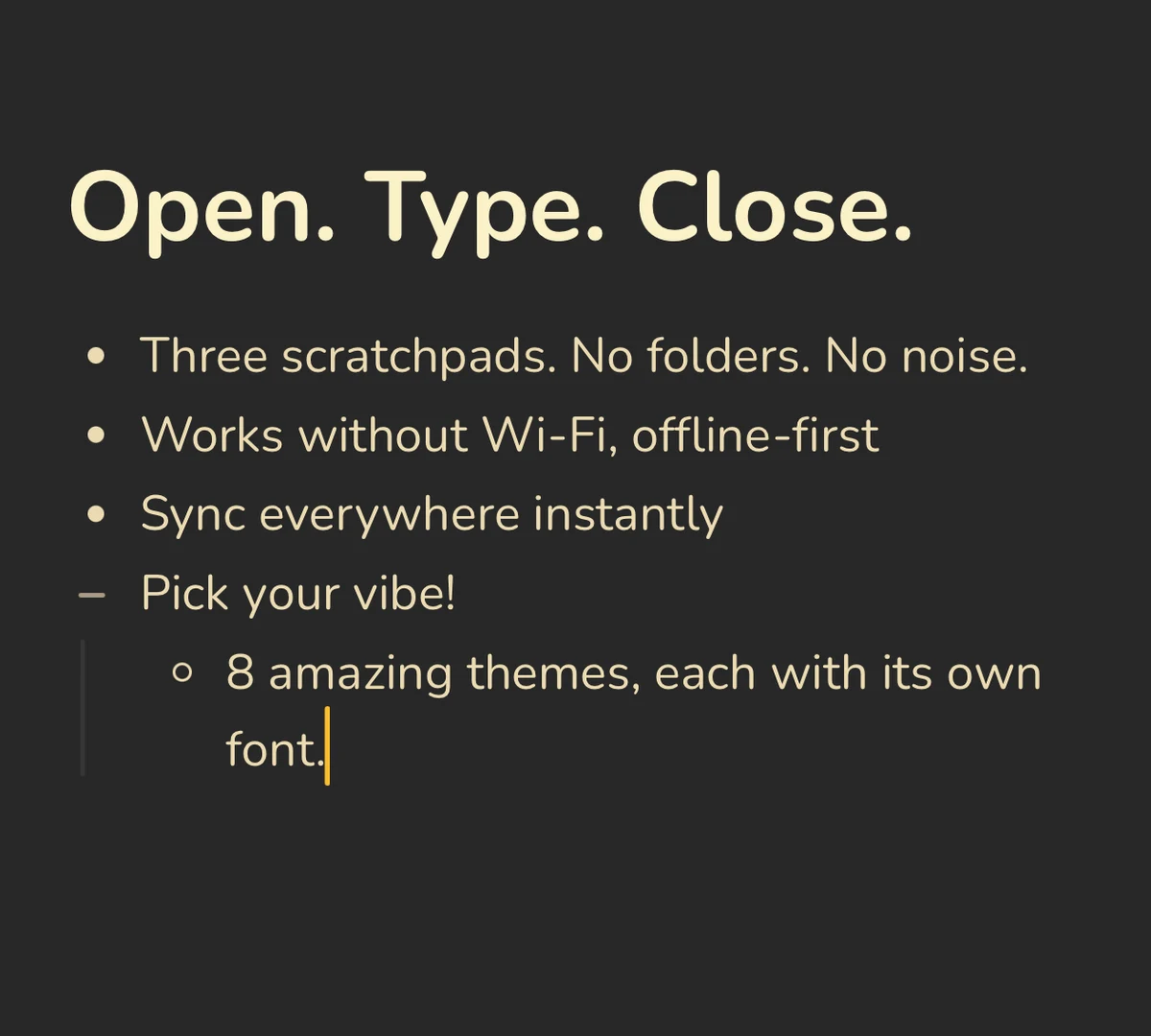 Benchpad Interface
Get Benchpad
On every platform
Native apps for iPhone & Android, and a Mac menu bar & Windows tray app — same three pads, offline-first, synced everywhere.
Benchpad
Try it free.
No credit card required.