Benchpad blog
The fewer decisions, the better the writing
The link between decision load and creative output is direct. Remove decisions from your tools and watch what happens to your thinking.
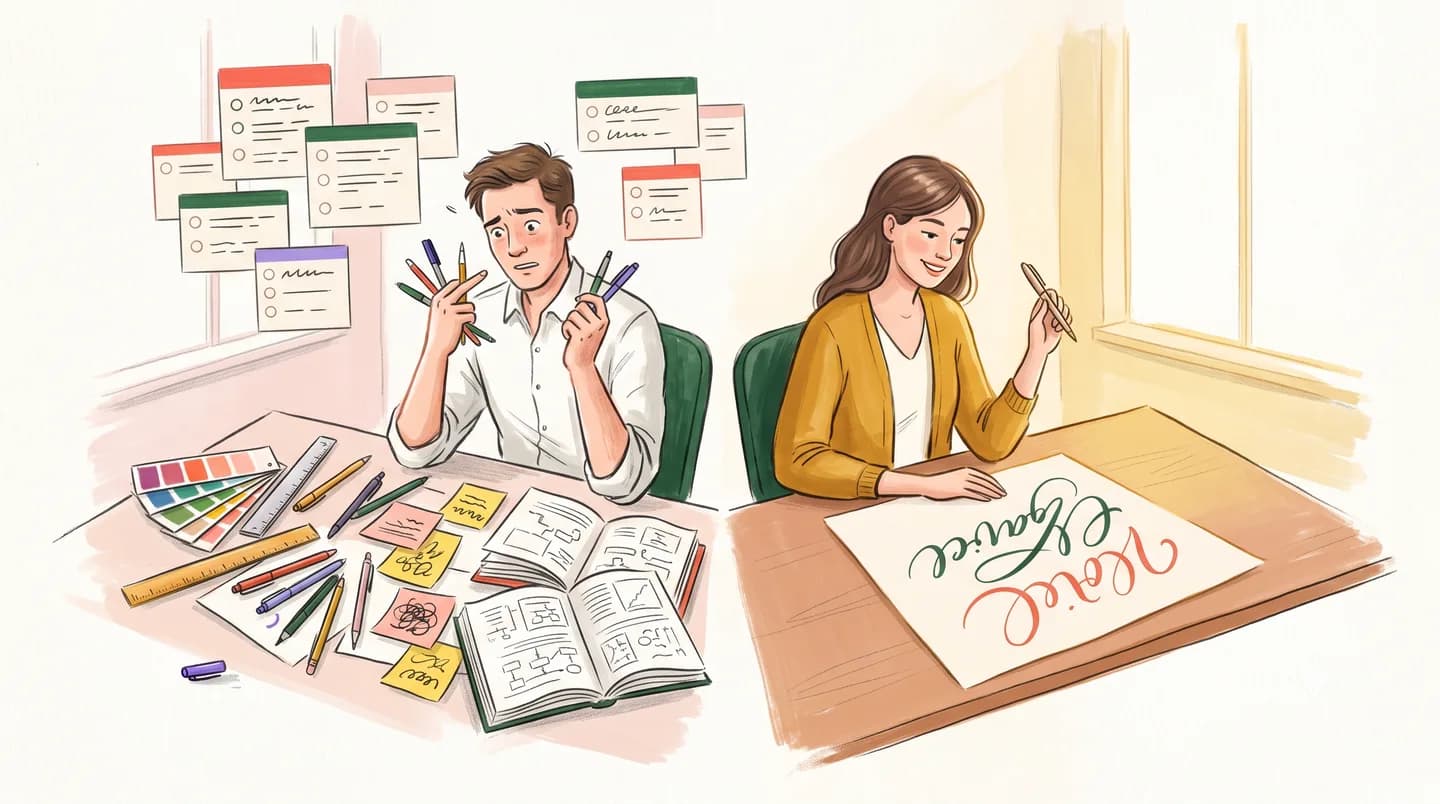
Ernest Hemingway wrote standing up at a chest-high desk in his bedroom. He used a pencil. He wrote on onionskin paper, always starting from the top of the page, always stopping mid-sentence so he'd know where to start the next day.
None of these were accidents. They were constraints he imposed to eliminate decisions from his writing process. Where to write? At the desk. What to write with? The pencil. Where to start? The unfinished sentence. How to end? Mid-thought.
The decisions were pre-made. The energy went to the writing.
The decision-creativity connection
Psychologists distinguish between "convergent" thinking (narrowing to one answer) and "divergent" thinking (generating many possibilities). Creative work requires divergent thinking. Decision-making requires convergent thinking.
These two modes compete for the same cognitive resources. When you spend energy making decisions, you have less available for creative generation. The relationship is direct: more decisions → less creative output.
This matters for note-taking because note-taking — real note-taking, not just copying things down — is a creative act. You're generating ideas, making connections, articulating things that were previously vague. It's divergent work.
A tool that front-loads decisions (where to save, what to tag, which template) is burning your divergent capacity on convergent tasks. By the time you start writing, you're operating on a depleted tank.
The research
The decision fatigue literature is extensive, but three findings are particularly relevant:
Baumeister (1998): Self-control and decision-making share a common resource that depletes with use. Each decision, no matter how small, draws from the same pool.
Vohs et al. (2008): Even trivial choices — red pen vs. blue pen, sit here vs. there — measurably deplete cognitive resources for subsequent tasks.
Iyengar & Lepper (2000): The famous "jam study." Shoppers presented with 24 varieties of jam were 10x less likely to buy any than shoppers presented with 6. More options → less action.
The implication for tools is clear: every option a tool presents is a jar of jam. Present enough jars, and the user does nothing.
Applying the research to tools
If the science says "fewer decisions → better output," the design implication for note tools is obvious: minimize the decisions required to start writing.
Here's what that looks like in practice:
Remove "where" decisions. Don't make the user choose where to put things. Either the location is automatic (one big document) or it's predetermined (a small, fixed number of places).
Remove "how" decisions. Don't offer formatting choices upfront. Let the user write first and format later, if at all. The blank page should be a blank page, not a formatting menu.
Remove "what" decisions. No template selection. No property configuration. No "what kind of note is this?" prompts. The note is whatever the user types.
Remove "when" decisions. Auto-save. No "save as" dialogs. No version management UI. The tool saves continuously and silently.
Each removed decision is a micro-investment in the user's creative capacity.
The compound effect
Individual decisions are small. The cognitive cost of choosing a folder is negligible in isolation. But decisions compound:
- 3 decisions to create a note × 5 notes per day = 15 decisions
- 15 decisions × 5 work days = 75 decisions per week
- 75 decisions × 50 weeks = 3,750 decisions per year
On note-taking. Just on the organizational overhead of writing things down.
Each of those 3,750 decisions could have been a sentence written, a connection made, an idea captured. They weren't, because the energy went to filing.
The zero-decision approach
Benchpad's approach is to drive the decision count to zero:
- No folder decision. Three pads, pre-named.
- No template decision. Blank editor, always.
- No tag decision. No tags exist.
- No save decision. Saves continuously, offline.
- No format decision. Write first. The editor handles the rest.
The result: thought → pad → writing. No decisions in between. The cognitive cost of capturing a thought is as close to zero as a digital tool can get.
The writing gets better. Not because the tool is doing something clever — because the tool is doing nothing, and that nothing is the feature.
Benchpad is three scratchpads. Zero decisions between thought and page. $10/year. Start writing free →
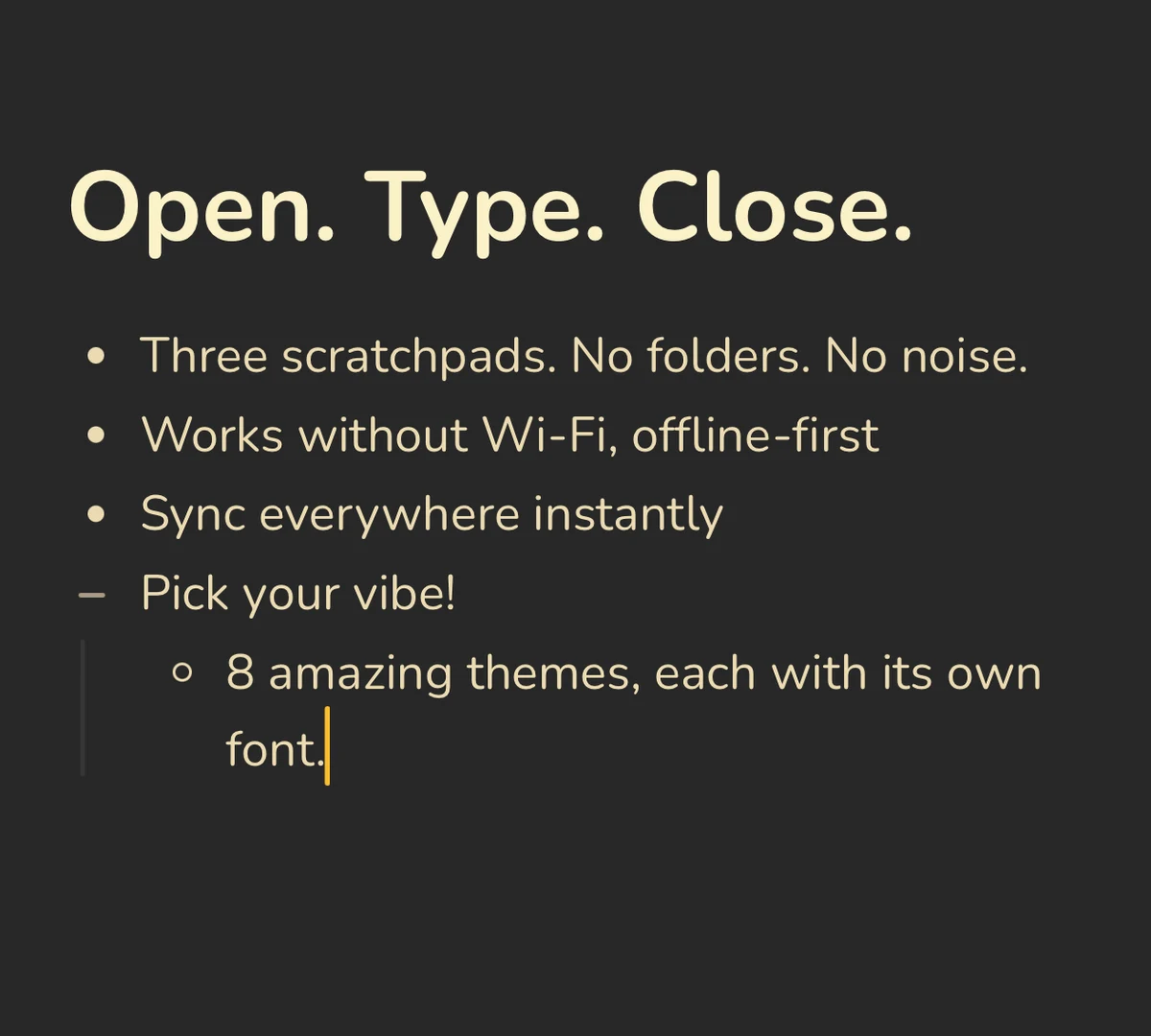 Benchpad Interface
Get Benchpad
On every platform
Native apps for iPhone & Android, and a Mac menu bar & Windows tray app — same three pads, offline-first, synced everywhere.
Benchpad
Try it free.
No credit card required.