Benchpad blog
Productive in five seconds
Real productivity isn't about the perfect system. It's about the five seconds between having a thought and writing it down.

There's a window. It's about five seconds long. It opens the moment you have a thought worth capturing and closes the moment that thought fades back into the noise of your mind.
Most productivity advice ignores this window entirely. It talks about systems, reviews, organization. But none of that matters if you can't capture the thought in the first place.
The five-second window
Research on working memory suggests that a new thought competes immediately with whatever else is in your mind. Within seconds, the details start fading. Within a minute, you might remember that you had a thought but not what it was.
Five seconds is generous. For complex thoughts — a nuanced idea, a specific phrasing, a connection between two things — the window might be two seconds.
This means the most important property of a note-taking tool isn't its organizational power, its sync capabilities, or its formatting options. It's how quickly you can go from "I have a thought" to "I'm writing it down."
Measuring the gap
Time the gap between "I want to write something" and "I'm writing" in your current note app:
- Lock your phone or switch away from your note app.
- Now pretend you have an urgent thought. Start timing.
- Open the app. Navigate to where you want to write. Start typing.
How long did it take? For most note apps, it's 5–15 seconds. That doesn't sound like a lot, but it's an eternity in the context of a fading thought. More importantly, each second of friction is a reason not to bother — a reason to think "I'll remember it" (you won't) or "I'll write it later" (you won't).
What slow capture costs
Every thought that dies in the gap is a loss you can't measure, because you don't know what you lost. But the aggregate cost is real:
Ideas. The shower thought, the mid-walk connection, the "oh wait" moment at 2am. These are your best thoughts — the ones that arrive uninvited, unrelated to what you're doing. They're also the most fragile.
Context. You might remember the gist of a thought later, but you won't remember the context: the specific phrasing, the connection that sparked it, the nuance. Context is where value lives.
Momentum. Each captured thought creates momentum. Each lost thought creates a micro-frustration. Over time, micro-frustrations compound into avoidance. You stop reaching for the tool.
The instant-capture benchmark
The gold standard for capture speed is: open app → write. Zero steps in between. No navigation, no file creation, no folder selection.
This is harder to achieve than it sounds, because most note apps are designed for reading and organizing, not for instant writing. They open to a dashboard, a list of notes, a sidebar. You have to navigate to the right place before you can start.
A tool designed for instant capture opens directly to a writing surface. Nothing between you and the blank page. The cursor is already blinking.
Speed as a design choice
Speed isn't just a technical property (fast load times, low latency). It's a design choice.
A tool is fast when:
- It opens to the writing surface. Not a dashboard. Not a file list. The page.
- It doesn't ask questions. No "where should this go?" No "which template?" No "title your note."
- It's always available. Works offline, so network speed is irrelevant.
- It's always in the same state. Three pads, same place every time. No navigation required because there's nothing to navigate.
These aren't features. They're the absence of anti-features. Each is a decision the tool made so you don't have to.
The productivity equation
Most productivity advice adds things: systems, habits, routines, reviews. But the highest-leverage productivity intervention is subtraction: remove friction between thought and capture.
If you capture 10 more thoughts per day, and 1 in 10 is genuinely useful, that's one extra useful idea per day. Over a year, that's 365 ideas that would have been lost. Over a career, it's transformative.
The five-second window isn't about productivity in the GTD sense. It's about not losing the raw material that everything else is built on.
What five seconds looks like
With Benchpad, the gap is this:
- Open the app. Your pad is already there.
- Start typing.
That's it. No navigation. No decisions. No loading. The pad you were on last time is the pad you see. The cursor is ready. Five seconds is generous — most people start writing in under two.
The tool isn't doing something clever. It's doing nothing, very quickly.
Benchpad is three scratchpads. Open and write. Nothing between thought and page. $10/year. Start writing free →
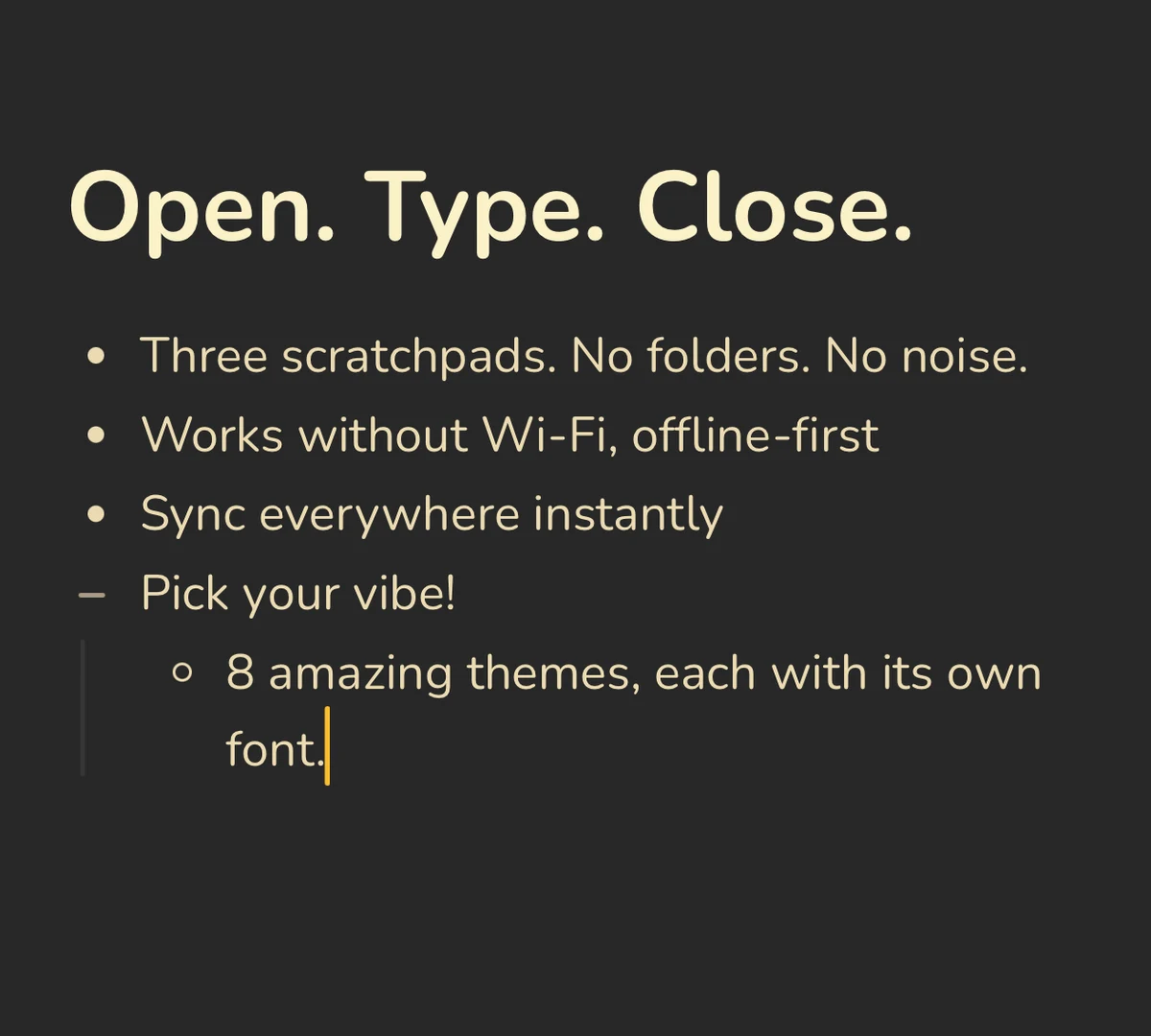 Benchpad Interface
Get Benchpad
On every platform
Native apps for iPhone & Android, and a Mac menu bar & Windows tray app — same three pads, offline-first, synced everywhere.
Benchpad
Try it free.
No credit card required.