Benchpad blog
Digital minimalism for your notes
You decluttered your closet. You unfollowed 400 accounts. Why does your note app still have 1,200 files you'll never open again?
You decluttered your closet. You unfollowed 400 accounts. You own one good pan instead of seven mediocre ones. And then you open your note app and there are 1,200 files staring back at you, most of which you wrote once and will never read again.
Digital minimalism has reached almost every corner of life — wardrobes, feeds, kitchens, calendars — except the tools we use to think. Your notes app is probably the most cluttered thing you own.
The accumulation problem
Notes accumulate differently than physical objects. Physical objects take up space you can see. A cluttered desk bothers you. But a note app with 800 files looks exactly the same as one with three: you still see the same search bar, the same sidebar, the same blank page.
This is the problem. Notes accumulate invisibly, and invisible accumulation is the hardest kind to notice and the hardest kind to stop.
Every note you create is a small commitment. Not a commitment to act on it — a commitment to decide about it later. Should I keep this? Where does it go? Is it still relevant? Every unprocessed note is a tiny open loop, and your brain tracks open loops whether you want it to or not.
Multiply that by a thousand notes, and you have a thousand micro-decisions waiting for you every time you open the app. You won't make those decisions, of course. You'll just scroll past them and feel vaguely bad.
What minimalism actually means for notes
Minimalism isn't about having less. It's about having only what you use. Applied to notes, this means:
Fewer places to write. Not 47 notebooks organized by project, area, and context. Three places. Maybe two. You should be able to hold your entire system in your head.
No organizational overhead. If maintaining your system takes time, your system is too complex. Tags, folders, links between notes — each is a decision you'll need to make every time you write something. A minimalist system has zero organizational decisions.
Nothing to maintain. A minimal note system doesn't need weekly reviews, inbox processing, or periodic reorganization. You open it, you write, you close it.
Finite capacity. This is the controversial one. Most note apps offer unlimited space because it sounds like a feature. But unlimited space means unlimited accumulation, and unlimited accumulation means the system slowly becomes unusable. A fixed, finite number of places to write forces you to keep only what matters.
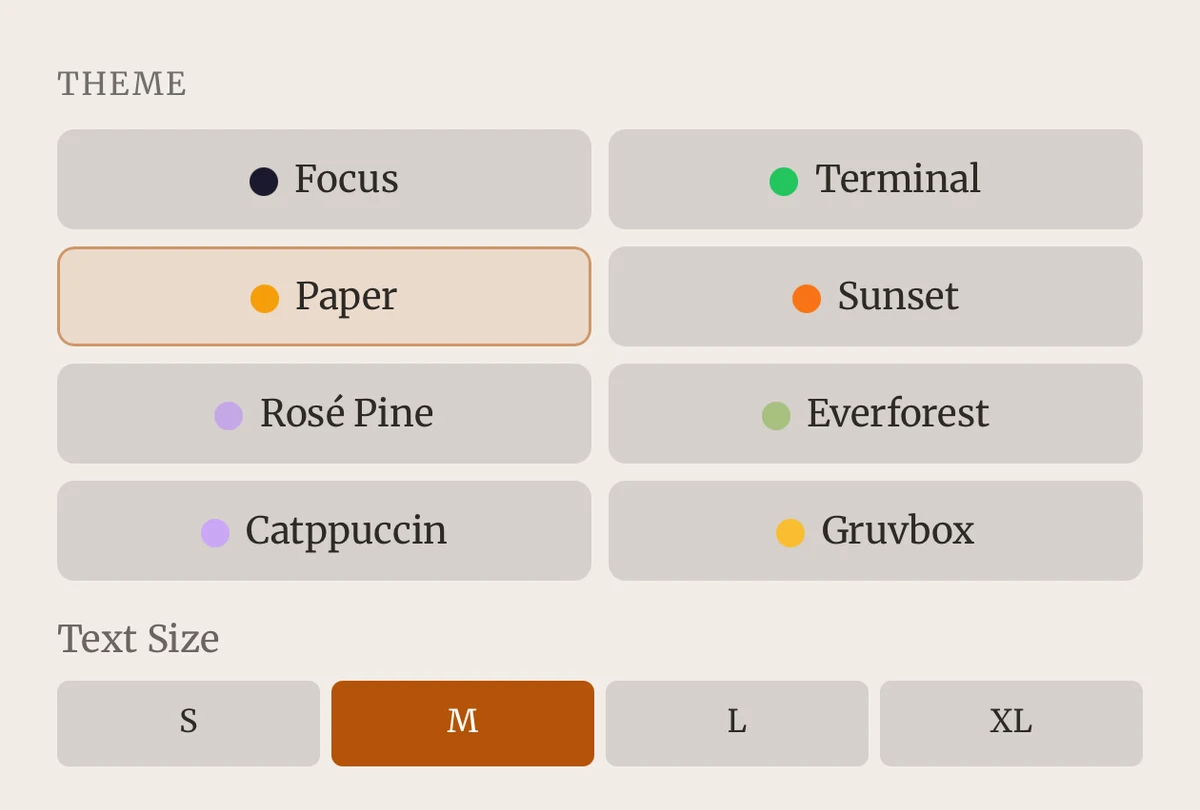 Benchpad Theme & Minimalist Mobile Interface
The three-pad model
Benchpad gives you three pads. Not three folders, not three notebooks with unlimited sub-pages — three pads. You name them. You write in them.
When you're limited to three, something interesting happens: you stop saving things "just in case." You keep what you're actively using and you let everything else go. The constraint does the decluttering for you.
This sounds limiting, and it is. That's the point. The limitation is the feature. It's what keeps the system from becoming another junk drawer.
The minimalism test
Here's a quick test: open your current note app. How many of those notes did you read or edit in the last month? If the answer is less than 10%, your system isn't helping you — it's a museum for thoughts you once had.
A minimalist alternative: keep what you use, in a system that makes it impossible to accumulate what you don't.
Benchpad is three scratchpads. No folders. No tags. No junk drawers. $10/year. Start writing free →
Get Benchpad
On every platform
Native apps for iPhone & Android, and a Mac menu bar & Windows tray app — same three pads, offline-first, synced everywhere.
Benchpad
Try it free.
No credit card required.