Benchpad blog
The cognitive science of writing things down
Working memory holds seven items for twenty seconds. Here's what the research actually says about why writing things down isn't just helpful — it changes how you think.
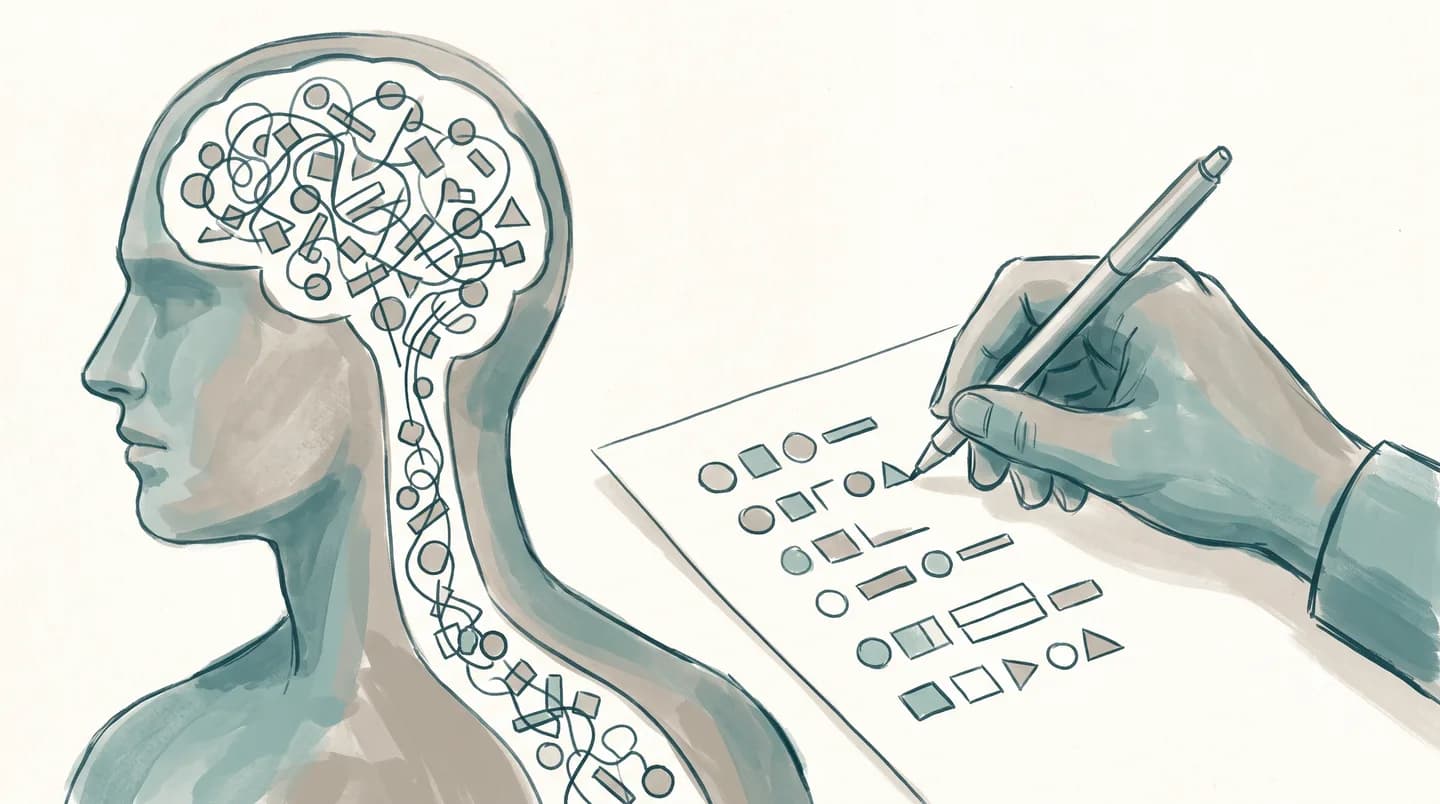
In 1956, the cognitive psychologist George Miller published a paper in Psychological Review titled "The Magical Number Seven, Plus or Minus Two." It became one of the most cited papers in the history of psychology.
Miller's finding: human working memory can hold roughly seven items simultaneously — and for most practical purposes, closer to four. Anything beyond that gets dropped.
Working memory also decays. Without active rehearsal, items disappear from it in about 15 to 30 seconds. You think of something. You don't write it down. Twenty seconds later, another thought arrives. The first one is gone.
This is not a failure of discipline. It is an architectural constraint of the human brain, as fundamental as the speed of light or the periodic table. You cannot will your way to a larger working memory any more than you can will your way to a higher IQ.
Writing things down is, at its most basic, an engineering solution to a biological constraint.
Cognitive offloading
The technical term for what you do when you write something down is cognitive offloading — externalizing internal cognitive states into the environment to reduce the processing load on the brain.
The concept was formalized by researchers including Evan Risko and Sam Gilbert, whose 2016 review in Trends in Cognitive Sciences defined cognitive offloading as "the use of physical action to reduce cognitive demands." Writing is the canonical example. So is a shopping list, a calendar, a sticky note on the door.
The insight is that the environment can be a component of cognition, not just a container for it. Andy Clark and David Chalmers made this argument philosophically in their 1998 paper "The Extended Mind" — the idea that cognitive processes are not confined to the skull but extend into the tools and artifacts we use. A notebook, on this view, is not a replacement for memory. It's an extension of it.
When you write something down, you are expanding your effective working memory by an amount limited only by the writing surface. The constraint becomes the pen, the keyboard, the screen — not the seven-item buffer in your prefrontal cortex.
The generation effect
Here is where it gets counterintuitive.
You might assume that writing something down reduces the need to hold it in memory, and therefore weakens the memory trace. You've offloaded it, so you can forget it — which means you do forget it.
This turns out to be true for some types of notes and false for others, and the distinction matters.
The generation effect, first documented by Norman Slamecka and Peter Graf in 1978, describes a reliable finding: information that you generate yourself — transform, restate, put in your own words — is remembered significantly better than information you passively receive or copy verbatim.
Taking notes by typing verbatim transcripts of what someone says produces weak memory traces. Paraphrasing, summarizing, and synthesizing — even imperfectly — produces strong ones. This is why students who take lecture notes by hand tend to outperform those who type, despite typing more words: handwriting forces paraphrase because you can't write fast enough to transcribe. The constraint forces processing.
Applied to personal notes: a note you write in your own words, connecting what you just read to what you already knew, creates a stronger memory trace than a paste of the original text. The act of writing is also the act of encoding.
This is the paradox of cognitive offloading: writing something down both reduces the burden of holding it in working memory (freeing up capacity for other things) and strengthens the long-term memory trace through the generation effect. You remember it better because you wrote it, and you can think more clearly because you no longer have to hold it.
Transactive memory
In 1985, Daniel Wegner introduced the concept of transactive memory — the idea that memory in social groups is distributed across members, not stored entirely in any one person's head.
A married couple forms a transactive memory system. She knows where the passports are. He knows who to call when the pipes fail. Neither has to remember both things. The system as a whole is the memory unit.
Wegner's research found that when people in close relationships are given information together, they spontaneously divide memory responsibility — the person more expert in a domain automatically becomes the memory node for information in that domain. The relationship creates a kind of shared RAM.
What's less discussed is that you can form a transactive memory system with your own notes.
When you consistently externalize certain kinds of information — in a reliable place, in a consistent format — you begin to outsource the storage function to the notebook without losing access to the content. You stop trying to hold command-line flags in working memory because you know exactly where to find them. You stop rehearsing someone's name because you have the meeting notes. The cognitive overhead of holding the information drops to nearly zero.
This only works if the external store is reliable. A transactive memory system in a couple breaks down when one partner stops remembering their domain. The human memory equivalent: if you don't trust your notes to be there when you need them, you can't offload to them — you have to maintain the internal backup. The unreliability reinstates the cognitive burden.
This is why "offline-first" is not a feature but a cognitive design requirement. A note app that might not load, might not sync, might not have your content when you open it — can't be trusted enough to offload to. You subconsciously keep the backup. The tool doesn't lighten the load because you can't trust it to hold it.
The Zeigarnik effect and unfinished tasks
In the 1920s, the Lithuanian psychologist Bluma Zeigarnik conducted a series of experiments based on an observation by her professor, Kurt Lewin: waiters seemed to remember unpaid orders better than completed ones. Once a bill was paid, the waiter's memory of it cleared almost immediately.
Zeigarnik formalized this into what became known as the Zeigarnik effect: incomplete tasks create a persistent cognitive tension — a kind of low-level mental alarm — that keeps them active in working memory until they are finished.
This is useful for focus: the tension motivates completion. It is a problem for everything else: tasks you can't complete right now continue to occupy working memory, creating what David Allen (in Getting Things Done) called "open loops."
Allen's insight — possibly the only genuinely useful thing in the entire productivity genre — is that writing a task down with a defined next action closes the loop, psychologically speaking. Not because the task is done, but because the brain can verify that the task has been captured in a reliable external system and doesn't need to be held internally.
The research partly supports this. A 2011 study by E.J. Masicampo and Roy Baumeister in the Journal of Experimental Psychology found that participants who had unfinished tasks performed worse on unrelated cognitive tasks than those who had completed the tasks — except when they made a specific plan for how to complete the unfinished task later. The plan dissolved the Zeigarnik effect. You didn't have to finish the task; you had to have a concrete intention captured for it.
Writing the task down — with some specificity — is the cognitive equivalent of completing it, for the purposes of clearing working memory.
What this means for how a note app should work
The cognitive science converges on a few requirements for a tool that actually helps rather than adds burden:
It must be immediately available. The bottleneck in working memory is speed of decay. If the tool takes thirty seconds to load, the thought is gone by the time you can write it. Offline-first, local-first architecture is a cognitive design requirement, not an infrastructure preference.
It must require zero filing decisions at the moment of capture. Deciding where a note goes is a working memory operation. It costs capacity. If you're deciding between twelve folders, you're using the same buffer you need to hold the thought you're capturing. The decision overhead isn't free.
It must be trustworthy enough to offload to. Transactive memory systems only work if both parties are reliable. A note app that might not have your content when you need it can't function as a genuine cognitive extension — you maintain the internal backup, defeating the purpose.
Writing in your own words matters more than completeness. The generation effect means a rough, paraphrased note that you composed is cognitively superior to a perfect verbatim copy. A tool that makes writing in your own words effortless — a blank page, no prompts, no templates — is more valuable than one that makes copying easy.
None of this requires an AI, a knowledge graph, or fifty folder types. It requires a blank page that opens immediately, saves reliably, and asks nothing of you before you start.
A final note on forgetting
There is a body of research on what is sometimes called "cognitive offloading costs" — the worry that using external memory makes internal memory worse. If you always write things down, does your brain stop trying to remember?
The honest answer: for low-value information, yes, and this is probably fine. There's no reason to maintain an internal address book when your phone holds one. The cognitive overhead of maintaining information that's reliably available externally is waste.
For high-value information — ideas you want to internalize, concepts you want to be able to call on fluidly — the generation effect suggests that the act of writing (not just reading back) builds the memory trace anyway. You didn't sacrifice the memory. You built it while capturing it.
The concern about notes weakening memory applies mainly to passive capture: copy-paste, verbatim transcription, screenshots without context. These give you the reference without giving you the encoding. They are retrievable but not internalized.
Active writing — making sense of something in your own words, even briefly — does both.
Benchpad is three scratchpads. Offline-first. Plain markdown. $10/year. Start writing free →
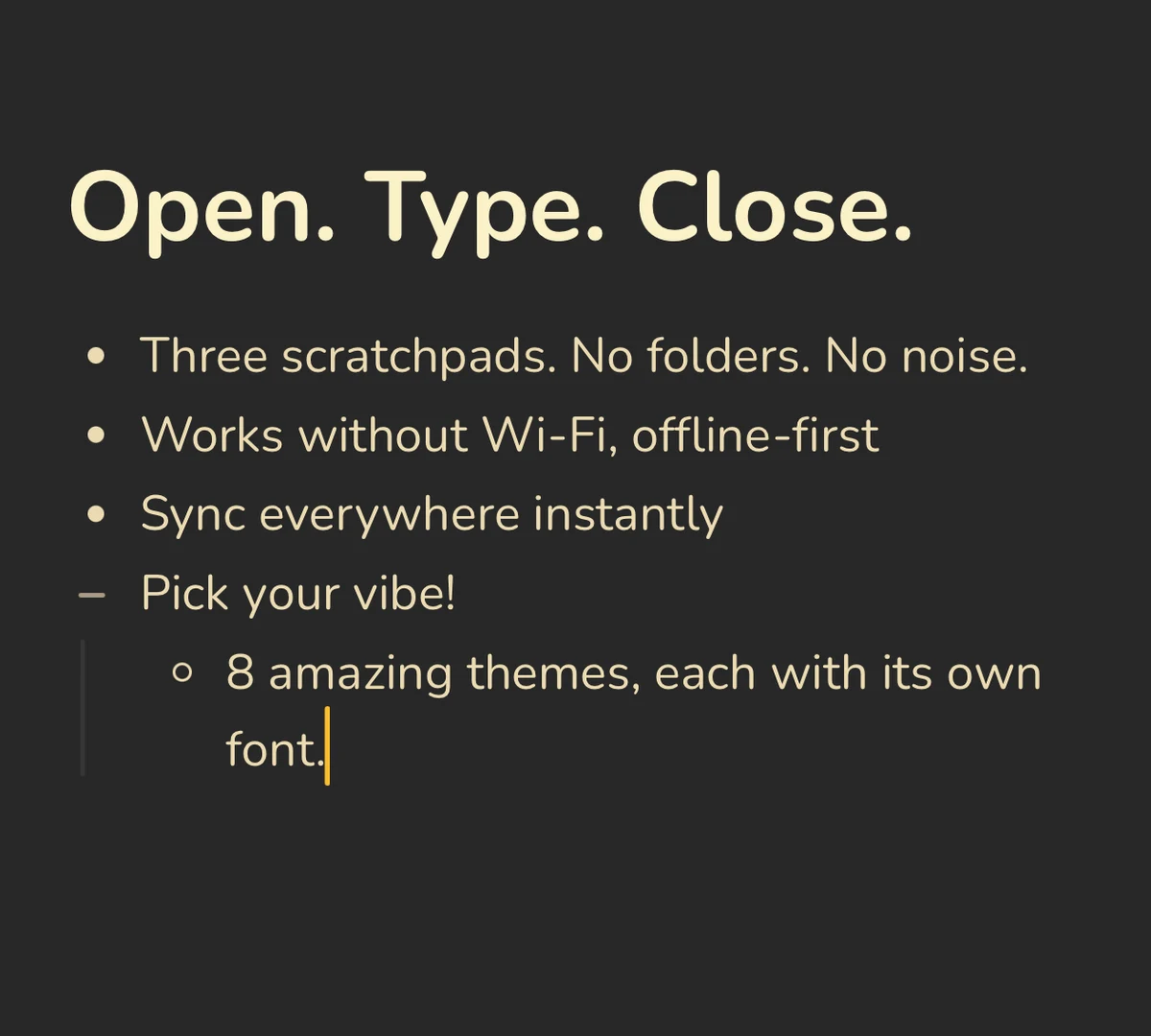 Benchpad Interface
Get Benchpad
On every platform
Native apps for iPhone & Android, and a Mac menu bar & Windows tray app — same three pads, offline-first, synced everywhere.
Benchpad
Try it free.
No credit card required.