Benchpad blog
500 years of personal knowledge management (before we called it that)
Before Notion, Obsidian, and Roam, writers kept commonplace books. The history of how humans have organized personal knowledge reveals something uncomfortable about the modern PKM movement.

In 1685, the philosopher John Locke devised a system for indexing his commonplace book.
A commonplace book — locus communis in Latin — was the standard tool of educated Europeans from roughly the 15th through the 19th century. It was a personal notebook in which the keeper would copy out passages from their reading, record observations, collect quotations, and occasionally write their own thoughts. Think of it as a hand-curated anthology of everything you'd encountered and found worth keeping.
Locke's indexing system was elegant. He divided the alphabet into twenty letters and two sizes — each letter had an entry for vowel-initial words and consonant-initial words. Forty categories total, covering the entire alphabet. To add an entry, you found the page indexed to your topic and added it there. If no page existed yet, you assigned one.
Locke was proud enough of this system to publish it in 1706 as A New Method of Making Common-Place Books. It was reprinted for over a century.
He was, in some meaningful sense, the ancestor of the Zettelkasten crowd.
What a commonplace book actually was
The word "commonplace" comes from the Latin loci communes — common places, or common topics. The original concept was rhetorical: Aristotle described commonplaces as the standard forms of argument that could be applied across subjects. A Renaissance education trained you to collect these standard forms, examples, and quotations so you could deploy them in debate, sermons, and essays.
Over time, the form evolved from a purely rhetorical tool into something more personal: a repository of whatever the keeper found interesting, useful, or beautiful. The structure was loose. Some people organized by theme. Some by chronology. Some not at all.
The users were not marginal figures. Francis Bacon kept a commonplace book. So did Isaac Newton, John Milton, John Keats, Thomas Jefferson, H.P. Lovecraft, and Ronald Reagan. Darwin's notebooks are effectively commonplace books annotated with his own analysis. Erasmus published a how-to guide (De Copia, 1512) that was essentially a 16th-century tutorial on building your personal knowledge management system.
This is not an obscure historical footnote. For roughly four centuries, the commonplace book was the universal technology of intellectual life.
The Zettelkasten
Niklas Luhmann was a German sociologist who died in 1998 having published 58 books and hundreds of articles. When researchers examined his working method, they found a filing cabinet containing approximately 90,000 handwritten index cards.
Luhmann's Zettelkasten — "slip box" — was a note-taking system built on the idea of linking cards to each other. Each card had a unique address. When he wrote a card, he would note any connections to existing cards. Over decades, the slip box developed something like an internal structure — webs of ideas that he could follow and mine for arguments he hadn't originally intended.
Luhmann described the slip box as a conversation partner. He claimed, with some literal seriousness, that it had its own intellect — that the connections it contained exceeded what he could have consciously planned.
The system was popularized in English largely through Sönke Ahrens's 2017 book How to Take Smart Notes, which triggered a wave of digital Zettelkasten implementations. Roam Research launched in 2020 with bidirectional links at its core. Obsidian followed. The "second brain" discourse ignited.
What almost none of the coverage noted: Luhmann's Zettelkasten worked because Luhmann used it for 40 years, writing by hand, making connections himself, and never outsourcing the thinking to the system. The method was the product of a lifetime's habitual use, not an initial setup.
The pattern
What's striking, looking across these systems, is how much variance there was — and how little of it mattered.
Locke's system was highly structured, alphabetical, indexed. Darwin's notebooks were structured thematically by inquiry. Jefferson's commonplace book was organized by subject matter. Keats's was organized by nothing at all — he just copied poems he loved.
None of them had the optimal system. They had the system they used.
The throughline across 500 years of personal knowledge management is not the method. It's the habit. The people whose commonplace books left intellectual traces in history were the people who used them consistently, not the people who devised the most elegant indexing scheme.
Erasmus didn't recommend a particular folder structure. He recommended reading with a notebook open and copying whatever struck you. The act of copying — which, for handwriting, involves the generation effect, the re-encoding of material in your own hand — was the point. The organization was secondary.
What the modern PKM movement got wrong
The contemporary personal knowledge management (PKM) space — Roam, Obsidian, Logseq, Notion used as a second brain — has imported the vocabulary and some of the techniques of these historical systems while missing what made them work.
Several things went wrong in the translation:
The system became the product. In the original commonplace book tradition, the system was subordinate to the reading and writing it served. You kept the book to support your intellectual work. In modern PKM, the system often becomes the intellectual work. People spend hours refining their Obsidian vault, writing plugins, designing workflows — and the actual reading and thinking atrophies.
Umberto Eco, who was a prolific note-taker and wrote about his method in How to Write a Thesis (1977), was emphatic on this point: the file cabinet was not the scholarship. It was in service of the scholarship. The moment it became interesting in itself, something had gone wrong.
Luhmann was an anomaly, sold as a method. The Zettelkasten worked for Luhmann because he was Luhmann — someone with a specific kind of sociological mind, building a specific kind of theoretical project, over a specific 40-year span. The system was an artifact of his work, not a precondition for it. The discourse around "building a Zettelkasten" treats the artifact as the cause rather than the effect.
This is cargo cult epistemology: imitating the external form of productive habits in hopes of acquiring their outcomes. Luhmann had 90,000 cards because he did 40 years of work. You will not do 40 years of work because you build a system that supports 90,000 cards.
Digital search eliminated the need for most organization. The commonplace book's organization existed to solve a retrieval problem: how do you find an entry when you have 500 pages of handwritten text? Alphabetical indices, subject headings, and thematic divisions were solutions to an engineering problem — analog search.
Digital search makes most of this unnecessary. A full-text search across your notes finds anything in milliseconds. The elaborate tagging systems, folder hierarchies, and bidirectional link structures that modern PKM tools encourage are solving a problem that, for most users, doesn't exist.
The actual retrieval problem in personal notes is not "how do I find things in my 10,000-note vault." It's "why do I have 10,000 notes and can't remember why any of them exist."
What the historical record actually shows about useful notes
If you examine the commonplace books that historians have actually found useful — the ones from which scholars have extracted insight — a few patterns emerge:
They were used actively. The books weren't repositories; they were working tools. Jefferson returned to his commonplace book throughout his life, adding and occasionally crossing out. Darwin's notebooks were annotated over years, with new observations layered onto old ones.
The notes were mostly short. A passage. A quotation. A brief observation. Not essays. Not elaborate structures. The length matched the thought.
The act of writing was the primary value. Renaissance pedagogy around commonplace books was explicit: copying a passage trained your prose style, embedded the content in memory, and forced you to evaluate what was worth keeping. The notebook was the output of a process that happened during copying, not the input to a process that happened during retrieval.
Retrieval was occasional and approximate. Locke's indexing system was not precise. It clustered entries by letter and vowel, not by keyword. You'd go to the index, find the section, and scan. The assumption was that approximate retrieval plus your own familiarity with the contents was sufficient. It was.
Three pads vs the second brain
The second-brain discourse is built on an anxiety: what if I forget something? What if I lose a connection? What if someone asks me about X and I can't retrieve what I know?
This anxiety is real. It's also probably misplaced.
The most intellectually productive people I've encountered don't have elaborate knowledge management systems. They have a few places where they write things down — usually simple, usually not optimized, usually used consistently. Their productivity comes from the writing and reading, not from the organizational sophistication.
The commonplace book tradition ran for 400 years on this principle. Keats wrote some of the most enduring poetry in the English language with a notebook he didn't organize at all.
The useful question is not: how should I organize my notes?
The useful question is: am I writing things down at all?
Three pads, named anything, used consistently, will outperform a perfectly architected Obsidian vault you can't make yourself open.
Benchpad is three scratchpads. Offline-first. Plain markdown. $10/year. Start writing free →
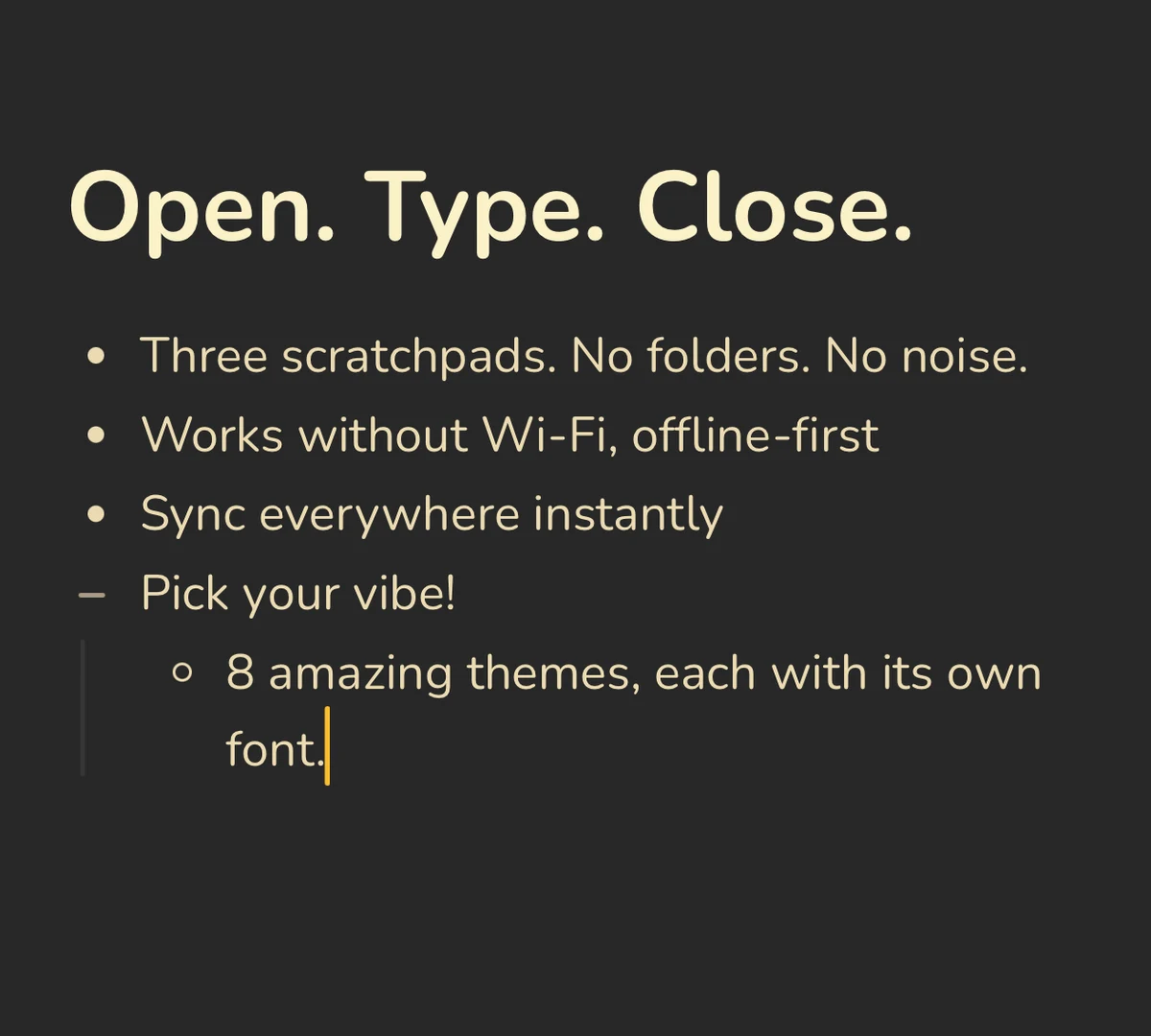 Benchpad Interface
Get Benchpad
On every platform
Native apps for iPhone & Android, and a Mac menu bar & Windows tray app — same three pads, offline-first, synced everywhere.
Benchpad
Try it free.
No credit card required.