Benchpad blog
Decision fatigue is killing your note-taking
Every folder choice, every tag, every template is a micro-decision. By the time you start writing, you've already spent your best thinking energy.
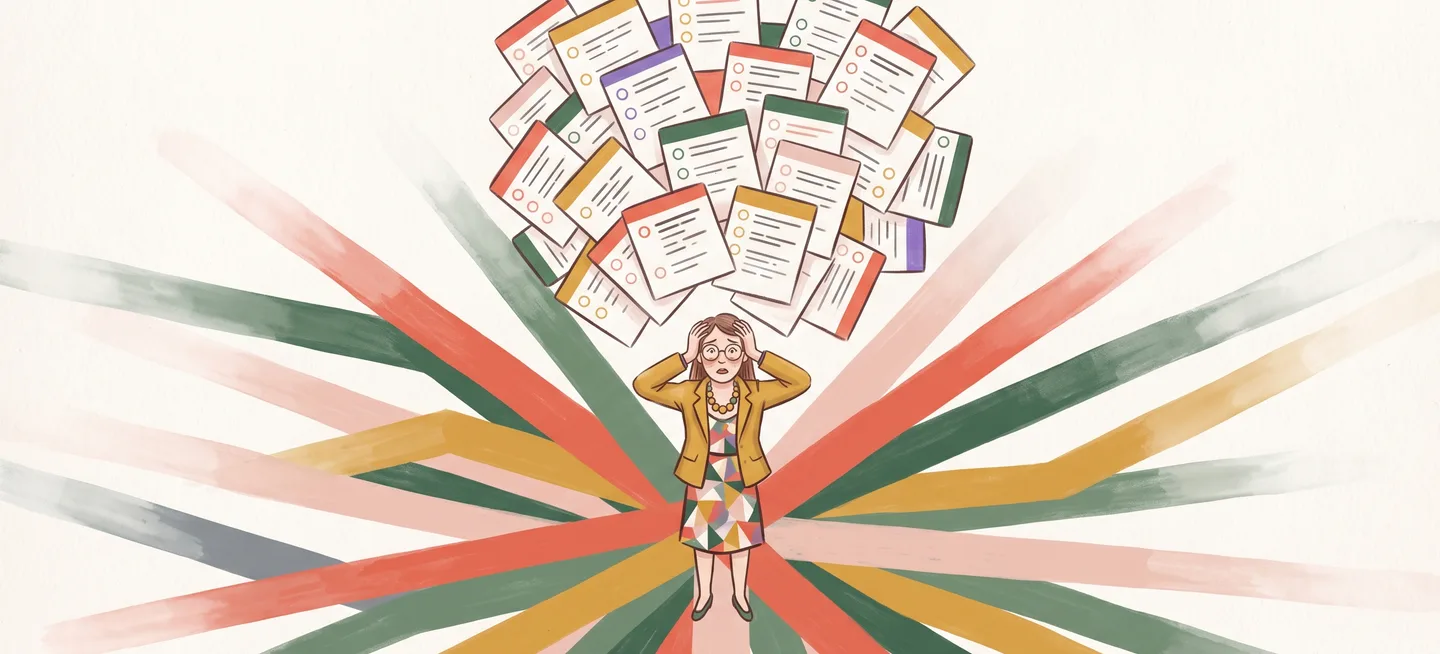
In 2011, a study of Israeli judges found that prisoners who appeared before the parole board in the morning received favorable rulings about 65% of the time. Prisoners who appeared in the afternoon received favorable rulings about 10% of the time.
The judges weren't biased by time of day. They were depleted. By afternoon, they'd made so many decisions that their brains defaulted to the easiest choice: deny parole and move on.
This is decision fatigue: the deterioration of decision quality after a long session of decision-making. It's one of the most robust findings in behavioral psychology. And your note app triggers it before you've written a single word.
The decision toll of taking a note
Here's what happens when you open a typical note app to jot something down:
- Where does this go? Which notebook? Which folder? Which workspace?
- What do I call it? Title the note. This sounds trivial, but naming things is a genuine cognitive task.
- What template? Some apps offer dozens. Each is a decision.
- What properties? Tags? Due dates? Priority levels? Linked notes?
- How should I format this? Headers? Bullet points? Toggle lists?
You haven't started writing. You've made five decisions. Each one is small. Each one costs energy. Together, they're the toll you pay to enter the app.
For something you need to do quickly — capture a thought before it vanishes — five decisions is an eternity. Most thoughts don't survive that kind of friction. You think "I'll write it later" and later never comes.
Why apps create decisions
Note apps don't create decisions out of malice. They create them out of flexibility.
Flexibility is the design philosophy of most modern tools: give the user options so they can build whatever system works for them. This sounds reasonable. But every option is a decision, and decisions have a cognitive cost that compounds over time.
The pitch is: "Our app can be anything you want." The reality is: "Our app requires you to decide what it is before you can use it."
This is the flexibility tax. You pay it every time you open the app, every time you create a note, every time you wonder "where should this go?" The tax is invisible because each individual payment is small. But the cumulative cost is enormous.
Decision fatigue compounds
Decision fatigue doesn't just make individual decisions worse. It makes everything afterward worse.
After a session of decision-making, you're more likely to:
- Procrastinate. The brain avoids decisions when depleted, which means you put off tasks that involve choices.
- Default to the easiest option. You dump the note wherever, skip the tags, ignore the organization. Your system degrades.
- Avoid the tool entirely. If opening the app means making decisions, you'll subconsciously avoid opening it. This is why so many people have note apps they "should use more."
The cruelest irony: the more powerful and flexible your note app, the more decision fatigue it creates, and the less likely you are to use it consistently.
Pre-deciding
The antidote to decision fatigue is pre-deciding: making decisions in advance so you don't have to make them in the moment.
In life, this looks like meal prep, capsule wardrobes, and default calendars. You decide once, then execute repeatedly without deciding again.
In note-taking, pre-deciding looks like:
- Fixed locations. Instead of choosing where a note goes, you have a predetermined small number of places. The structure is decided. You write.
- No tagging. Tags require classification decisions. Remove tags, remove decisions.
- No templates. Templates require choosing. A blank page requires nothing.
- No titling. Or at least, no mandatory titling. The content is the note. A title is metadata you can skip.
Each of these is a decision removed. Each removed decision is cognitive energy preserved for the thing you actually care about: the writing itself.
The three-pad pre-decision
Benchpad takes pre-deciding to its logical conclusion. You have three pads. You name them once. Every future note goes in one of three places.
There's no "where does this go?" because there are only three answers, and you already know which pad is for what. There are no tags, no templates, no properties. You open a pad and you write.
The number of decisions between "I have a thought" and "I'm writing the thought" is zero. That's not a simplification — it's a design philosophy. Every decision removed is energy preserved.
What you get back
When your note app stops demanding decisions, you get back two things:
Speed. Thought → open app → write. No organizational overhead. No filing. No classification. The thought survives because the path from brain to page is frictionless.
Energy. The decisions you didn't make on note organization are decisions you can make on things that matter: your work, your creative projects, your actual problems. Decision capacity is finite. Spend it where it counts.
Benchpad is three scratchpads. Zero decisions. All your energy for the writing. $10/year. Start writing free →
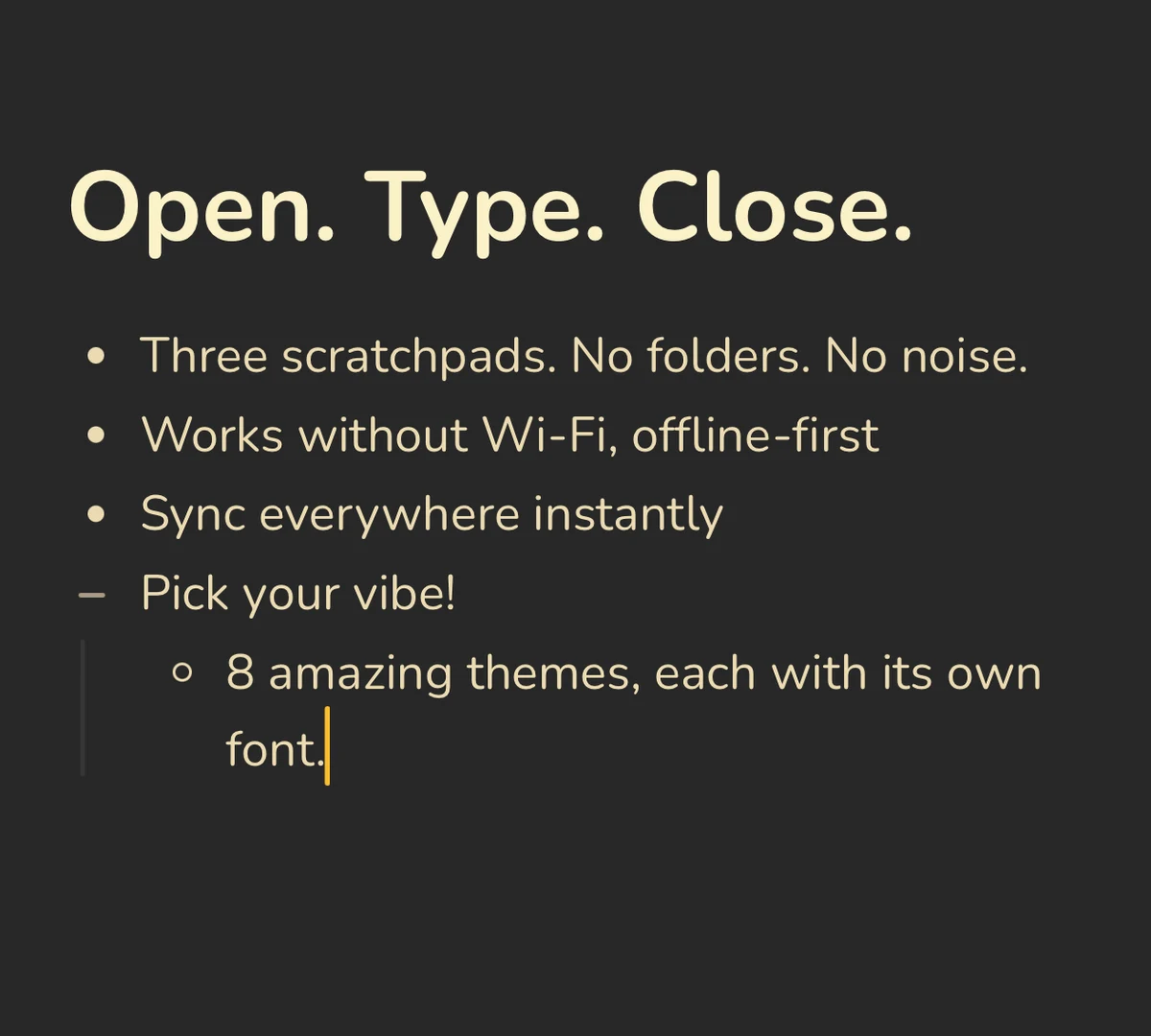 Benchpad Interface
Get Benchpad
On every platform
Native apps for iPhone & Android, and a Mac menu bar & Windows tray app — same three pads, offline-first, synced everywhere.
Benchpad
Try it free.
No credit card required.